
4 best practices I learned from creating content on the web - that I am now using in my analytics job
Want to increase the data culture of your organization? Take a few pages from the content creators' playbook

Disclaimer: While I have always loved finding patterns between different fields - unfortunately, my audience doesn’t seem to like these articles (e.g. my article on “What Data Practitioners Can Learn from Dog Trainers” is one of my lowest performing articles). Hope this one will turn this trend around :)
Are you part of an analytics team? Congrats - you are a content creator!
You create content that you share on internal social media - with a dream of seeing your work being shared everywhere and being “faved” by your stakeholders. Your decks, your slides, your docs, your graphs and charts - all of this is content that you build for your audience (aka your stakeholders within the organization), and that you want to be consumed and digested to have a real-life impact.
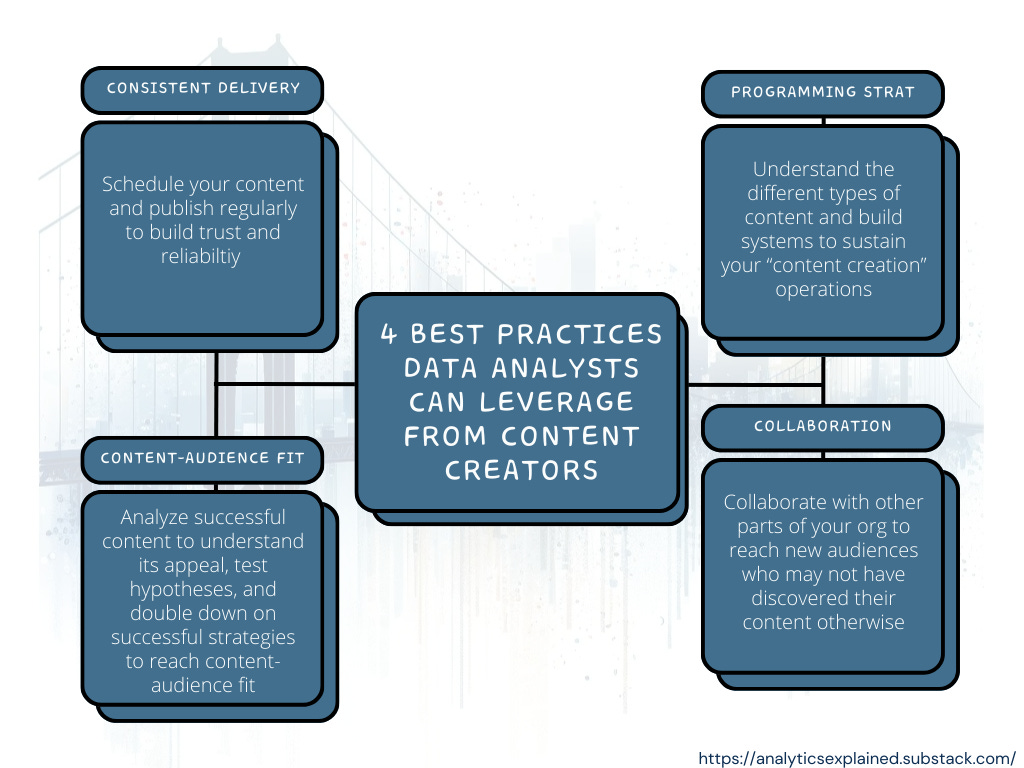
This is in a nutshell what I realized as I started writing content on the internet. And as I started learning more about how to be successful as a content creator, I discovered a few best practices that I began reusing in my analytics jobs - which proved to be extremely effective at increasing the data culture of my org (which is one of the pillars of analytics maturity, as discussed in this previous article). I curated my 4 favorites below.
Best practice #1: Sticking to a consistent publishing schedule
To become successful as a content creator, consistency is key.
From an audience perspective, when you publish regularly, they know when to expect new content, and that builds trust and reliability. This allows you to stay top-of-mind over time, and to grow a loyal follower base.
From a “you” perspective, it allows you to build discipline, and it forces you to build systems to help you deliver on schedule (and you know how much I love systems). You have to plan your content strategically, to consider trends, audience feedback, and personal goals - which all lead to more thoughtful and impactful content.
How you can transfer that into the Analytics world:
Build a publishing schedule, communicate it, and do your best to stick to it
(Optional) Start organizing weekly / bi-weekly forums / deep-dives into some specific topics, as a “distribution” venue for your scheduled content
Best Practice #2: Defining your programming strategy
Your programming strategy is your strategy when it comes to content creation and publishing.
It encapsulates a large array of elements - all the way from idea selection to the outro of your content. It is supposed to be the system that will allow you to stay consistent over a long period of time. That’s why it is so important.
When I started writing, I didn’t have one - which led me to take a hiatus of several months as there was no process behind what I was doing. But during this hiatus, I started reading more and digging more into the concept programming strategy - which led me to find two very valuable frameworks:
The 3H framework:
The idea is to build your publishing schedule around 3 types of content:
The hero content: high-impact, broad appeal content, will bring in new audience, but will require a lot of work
The hub content: regularly scheduled, keeps existing audience engaged, turn new audience from hero content into loyal fan
The help content: educational, “evergreen”, always bringing in a baseline of viewer - that can then be turned into loyal fan with the hub content
By having the right mix of hero + hub + help, you can make sure to optimize your time and efforts for maximum impact.
The “Minimum Viable Content” (MVC) framework:
The idea is to use short-form content (e.g. Twitter, TikTok) to test an idea and see how your audience reacts to it. If you have good engagement - then invest the time to create the long-form version (e.g. Medium, YouTube).
You can mix this framework with the previous one - you can test an idea in a “hub” format, and if you see great engagement, dig deeper into it and build hero content.
How you can transfer that into the Analytics world:
From experience - most data studies “fail” to deliver the right amount of value because they don't clearly understand the needs of the audience. Using the MVC framework, whenever you see something of interest, you can quickly pull a chart and run it through a subject matter expert to understand if this is worth digging into, instead of investing a lot of time and effort into a long, but not interesting study.
Taking some inspiration from the 3H framework - you can optimize the value you bring to your stakeholders while building a strong personal brand by playing with the different types of content:
You can publish Hero content (deep dives into specific topics) on a monthly basis - that will allow you to get more visibility while answering key questions for the business
You can publish Hub content (regular forums, newsletter) on a weekly basis - that will keep you relevant / top of mind while building a community internally
You can publish Help content (“101” docs, FAQs) when you see fit - that will help put you / your team on the map while providing value for neophytes
Best Practice #3: Seeking content-audience fit
We just talked about “Minimum Viable Content“ - there is another concept we can take from the startup world: “Content-Audience fit”.
Just like startups need to find “product-market fit”, creators need to find “content-audience fit”: what content resonates the most with their audience so that they can build more of it, and grow a community. Creators have several tools at their disposition to do so - one approach that I found particularly interesting comes from Nicolas Cole. In his article “How to Turn One Breakout Data Point into Multiple Dozen of Proven Content Ideas”, he advises creators to do the following:
As soon as they have a very successful piece of content, they should write down a few hypotheses as to why it was successful
They should test each of these hypotheses in subsequent pieces of content
Once they have figured out the recipe of success, they should double-down on it
At the same time, they should start thinking about other pieces of content that would be interesting for the audience they are currently catering to (also known as affinity analysis in the data world)
How you can transfer that into the Analytics world:
If you find yourself often presenting to the same audience over and over, you can usually develop an understanding of “what makes them tick”, and how they prefer to consume their data. Being very mindful of who is your audience and what they believe can help you make your point stronger / straighter to the point / more effective
A disclaimer though - there is intrinsically a need for data analysts to be unbiased, and to present results the way they are (and not make them fit a preconceived story). It is important to find the right balance between catering to your audience and being comfortable with presenting data points that won’t necessarily make them happy
Best Practice #4: Collaborating to distribute your content more widely
Collaborations between content creators offer several key benefits::
Audience expansion: by collaborating, creators can tap into each other's audiences, exposing their content to new viewers who might be interested but haven't yet discovered it. This cross-pollination of audiences can significantly boost visibility and follower counts.
Fresh perspectives and diversity in content: collaborations bring together different styles, ideas, and strengths, leading to more diverse and innovative content. This variety can make the content more engaging and appealing to a broader audience.
Learning and skill sharing: working with other creators allows for the exchange of knowledge and skills. Creators can learn new techniques, tools, and strategies from their collaborators, enhancing their own content creation process.
Increased credibility and trust: when a respected creator collaborates with another, they essentially give a vote of confidence to each other. This endorsement can help build trust and credibility with both of their audiences.
Networking and relationship building: collaborations are a great way to build professional networks within the content creation community. These relationships can lead to more opportunities, support, and collaborations in the future.
How you can transfer that into the Analytics world:
Organize collaborations with people from other data teams. This can create very interesting work (as you are mixing skill sets and perspectives from different sides of the business); it will give you an opportunity to do some great networking and relationship building; and overall it will be a great way to distribute your content to a larger audience.
Conclusion
Data analysts can take a few pages from content creators’ playbook:
Setting up a consistent publishing schedule
Being intentful about their programming strategy
Focusing on content-audience fit
Doing some collab’
While “content is king” and those best practices will never replace making actual quality work - adopting some or all of them can help make sure your content is more impactful and digestible for your audience (and - bonus points - can earn you a few fans internally).
If you liked this article, check out these ones: